
The Looming Shadow
On grand tension in fiction

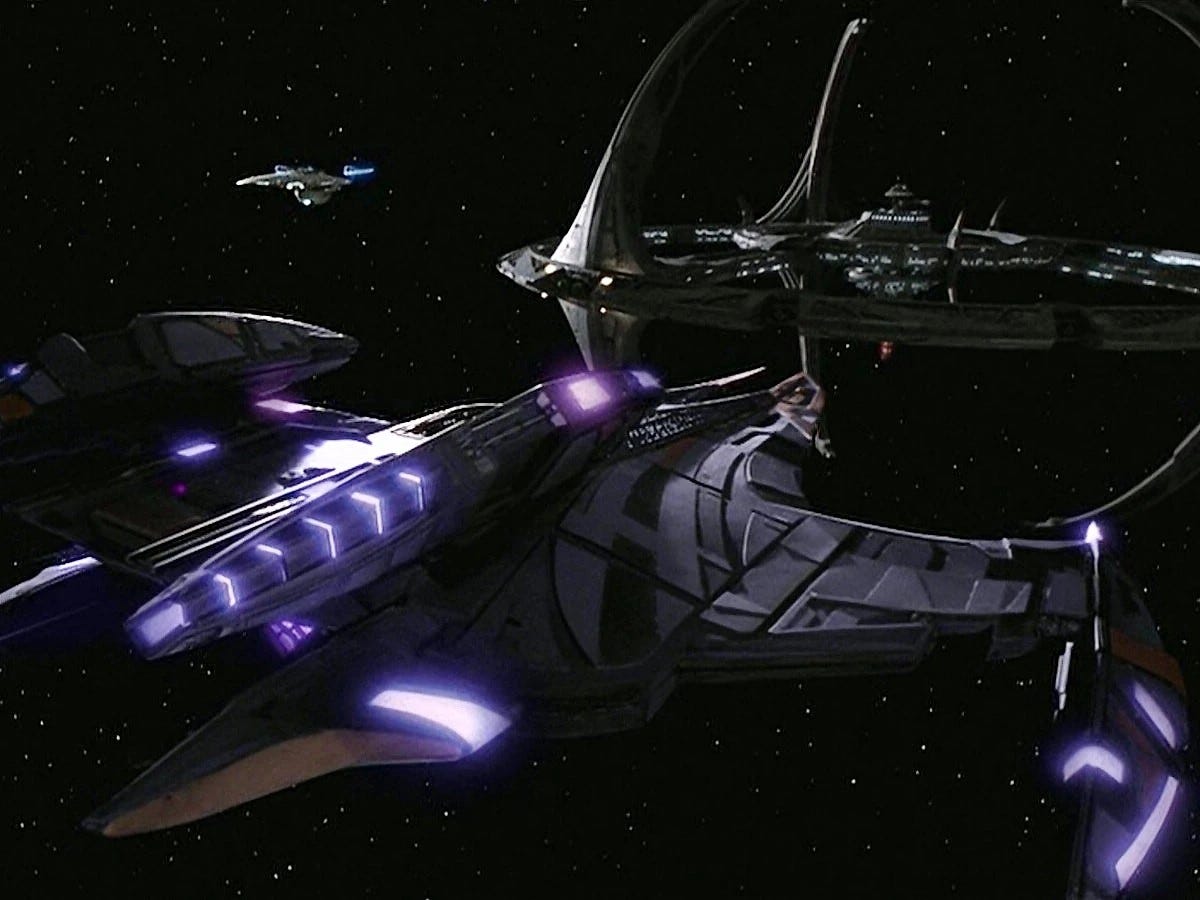
Something dawned on me recently while watching Star Trek: The Next Generation (TNG). The episodes that most grabbed me were those in which there were negotiations between the great powers of the galaxy to avoid conflict. Anytime where the peace seemed to hang by a thread, where any wrong move could cause the whole edifice to crumble down on everyone’s head. Then the dogs of war would be let loose and havoc would reign. I just can’t get enough of that.
Tension is integral to narrative as it is. Conflict generates it within the story and we, being the curious creatures we are, become irresistibly drawn into it. The possibilities are there, we can mentally explore them, but are unable to penetrate the opacity of the future to know what the ending will be, and in there lies the excitement. In a way, it's reminiscent of the thrill the gambler feels when he rolls the dice, the possibilities are known, but the outcome is not. They are all combined together with the rush of potential victory and the agony of defeat, all experienced together in a single moment suspended in anticipation as we wait for the dice to fall and actualize the potentials we see.
But, what is it about grand confrontations which grabs us, or really me, so powerfully in a different way to that ordinary tension? It's a unique form, an extension of the anticipation felt in any standoff. The sheriff and the outlaw in the saloon, the warrior and his opponent, the prosecution and defense. All of these forms of confrontation between two opposing sides can produce a form of this feeling. The expectation that behind the words and posturing is coiled violence whose release would be catastrophic for one party or the other.
When this micro level tension is paired with a macro level behind it, that is when everything reaches a new height of anticipation. That single taught bowstring becomes a condensed symbol of the wider waiting conflict. Instead of the one faced off against the other, with just their consequences in the balance, it’s whole armies and nations which are at stake. The individual protagonist-antagonist conflict is deepened and at the same time somehow less within their control. Each becomes an avatar for much larger powers which have a will of their own that propels them, perhaps against these characters’ own desires, towards an end.
The dance between both sides becomes one of monstrous significance, with many others watching on with investment, but no way to escape the potential consequences ushered in upon them. They become swept away by the decisions of others, fastened to the ships mast lest they fall into the waters of chaos. Best to take the chance of war than to brave that endless depth of the unknown alone. Be they civilian or soldier, politician or merchant, they are all shackled to those decisions of others which we are privy to in the story. The characters become invested with the same tension we as the audience experience.
Think to the real-world example par excellence, the Cuban Missile Crisis. Two sides in a crisis of confrontation, neither willing to back down. Each seemingly prepared to take the world to its demise instead of lose face to the other, signaling their inferiority and submission, admitting defeat in their ideological rivalry, saying once and for all that all they believe is not the best way. The whole world watching and unable to breathe through the thickness of the unbearable tension as the Bear and Uncle Sam hover over the keys to the ending of the world. all are impacted but unable to exercise anything near agency to affect the outcome of the titanic struggle between the two.
Or another historical relic, which continues on today, the meeting points between North and South Korea in the Demilitarized Zone, visually displays the tension between both sides of a frozen conflict. A place where both sides have time to posture and signal, to each other and to themselves. Guards are placed in their appropriate regalia to say to whoever is their opposite number exactly who they are dealing with. This was transplanted so well in fiction by the redone Battlestar Galactica. The space station where the Humans and Cylons were supposed to have regular meetings to pursue peace. It served both as a focal point for the overall strategic tension and as the release for that anticipation when it is destroyed by the Cylons in their return to the 12 Colonies in the beginning of the series.
Star Trek Deep: Space Nine (DS9) has a masterfully done example of grand tension being played out in the season 5 episode Call to Arms. The Dominion, a hostile power from across the galaxy which has established a foothold in the alpha quadrant (where the majority of all Star Trek is based). They bring a massive warship to DS9, an indication visually of the power they can bring to bear. They come to confront Captain Benjamin Sisko, representing the Federation, on the mining of the Bajoran wormhole, the only route for the Dominion into this part of the galaxy. Mining the wormhole effectively cuts off any Dominion reinforcements from crossing into this part of the galactic map, it is a blockade, an act of war. The viewer knows that Sisko’s answer to the Dominion representative Weyoun will decide whether there will be peace or war. The scene is short and to the point.
SISKO: What can I do for you, Weyoun?
WEYOUN: Captain Sisko. I'll make this brief. We know all about the minefield.
SISKO: I assumed you'd find out sooner or later.
WEYOUN: As I see it, you have two choices. Either you remove the mines or we will take this station from you and remove them ourselves.
SISKO: I appreciate your directness. Now let me be direct with you. The mines stay. I will not allow any more Dominion reinforcements through the wormhole.
WEYOUN: You will not allow?
SISKO: You heard me.
Afterwards the scene plays out as if there were a mediation going on. That perhaps there was a way to avoid war with small concessions by each to preserve the status quo. The show attempts to lull the inattentive into the belief that the conflict is stalled, and the tension of unrealized potentials is still ongoing. But the next scene brings home the reality.
SISKO: They're going to attack.
BASHIR: Are you sure?
SISKO: I am positive. The moment I mentioned that we weren't going to remove the mines, we both knew there'd be war. Everything else was just words, a feeble attempt to lull the other side into a false sense of security. I didn't buy it, and I'm sure Weyoun didn't either.
And so the next two seasons of DS9 are seasons detailing the result of this discussion. The impact of one decision ripples out across the story, worlds will burn and characters will die. Its import only grows upon watching the series again, since one knows the consequences all too well, you know what is coming that much better, and so its importance becomes magnified.
Another example which crosses my mind, while rather unorthodox, I still think fits the theme, is Christ’s trial before Pilate. When Christ is brought before Pilate there is a tension, between the forces of heaven on one hand, and the forces of the world on the other. While Pilate has the Empire of Iron and its Legions behind him to enact his will, Christ has heaven on his side, the Stratias (Greek for army) of Angels which heralded his birth standing at the ready. So, when Pilate and Christ face off together, there is the tension of worldly power against the heavenly one. The resolution of this however is most unusual of course, the conflict seems over and done with the crucifixion and death of Jesus. It appears that Pilate, Rome, the world, are more than the match for Christ and the hosts of heaven. Only for that subversion with the resurrection, a proof that God’s ways are not our own and that He transcends us in ways we cannot fathom. That the tension we felt was unwarranted since the heavenly power has no equals despite all appearances to the contrary.
One thinks of Stalin’s remark, how many divisions does the Pope have? And how it echoes Pilate’s own retort of “what is truth?” John 18:38. Both are absolutely secure in their view that they hold the upper hand, only to find out later they were deeply mistaken. With millions of tongues confessing crucified under Pontius Pilate for eternity and the fall of the hammer and sickle coming in no small part from the division poor successor of St. Peter.
This same theme ends up being reflected in the ending of Msgr. Robert Hugh Benson’s dystopia The Lord of the World. The books climaxes with the whole worlds military might, united under the anti-Christ who brought world peace, comes to snuff out the last vestige of the Church in a last terrible strike. We are treated to the grand tension of the world again massed against heaven. The tension builds in a crescendo on both sides. The last of the Church, the final Pope and his remaining clergy conduct Mass one last time as the force of the world prepares to annihilate them. As the Mass reaches its height with the consecration of the Eucharist, the weapons are let loose, and the book simply ends “Then this world passed, and the glory of it”. The power of God intervenes directly in the way it has always promised to but in a way that, like the crucifixion, we do not truly expect. Like the upending resolution of the resurrection, this victory is unexpected despite the massive imbalance between the finite and the infinite, our minds place the visible finite on the scales much more heavily than they deserve. We see the power of the world assembled against the invisible army of God, and conclude that we should know the outcome. The Grand tension we feel is that of dread as evil apparently overtakes good, the forces of darkness blotting out the light, only for that to be transcended.
Parting thoughts
The difference I am trying to tease out here is admittedly subtle but I think it is most definitely there. It’s part of the reason I’ve never strongly resonated with stories without some fashion of this type of tension. The smaller intimate tales of family or the individual, while compelling to most I often find falling flat in terms of my own interest. I crave the edge of the seat moments between the great powers and the cosmic drama of good and evil.
My other interest in this topic comes from the times we live in. Grand tension in fiction is reliant on grand or meta-narratives, since only those are able to propel great swaths of men into collective action. The boogey man for many today is “post-modernism”, as frequently maligned as it is misunderstood. What post-modernism is at heart is a skepticism of grand narratives, of the weaving together of events and facts into a cohesive structure. Ironically, this take itself is a grand-narrative, a very poor, weak, and myopic one, but one none the less. Under this banner many of the old narratives of life have been merciless attacked and shorn of much of their hold on most peoples lives. A vast mass of humanity now is taught a rather anemic substitute gruel as an alternative.
To reject all stories is to replace it with a new narrative of atomization and nihilism which neatly eliminates this category in our lives. There can be no grand coalition to defend freedom, no grasping for imperial glory, and certainly no cosmic war between the light and the dark, of good and evil. All those things which call us outside of ourselves become suspect, creating a much darker and more selfish world.
Whatever grand narrative captivates you, be it freedom, salvation, or glory, make sure it elevates you out of yourself and for others, for that is the path away from being a small soul and towards a larger one which overflows into the world. It will leave both you and the world richer.
The Lord of the World reminds me of the last Divine Liturgy/Mass in Constantinople with Latins and Greeks sharing in the last ever mixed communion between the two post Schism. This grand scene plays out the night before the Saracen breaks down the Theodosian walls of the great city and the city is changed to what it is today.
This grand tension is something we look for also in sport. The greatest and most popular sports are able to build tension until they crescendo in these epic moments that will live on in time. The Miracle on Ice, The David Tyree helmet catch for the Giants in the Super Bowl, or the penalty kicks to secure the Italian Euro victory (football) over England in 2021.
Love this study of tension!
It certainly resonates with what we are seeing today in this world